Inspired By A Photograph | Valentina Cirasola | Interior Designer

It’s not uncommon in my world of art and design to see an art image and think of something else that has nothing to do with the painting subject. I have a great admiration for people’s art and visions of art. Looking deeply into the artist’s color selections, or interpreting the artist’s thoughts often put me in a state of transcendental thinking, wandering in the maze of my imagination that creates more images and more ideas.

This is what happened when a few months ago I saw this photograph on Google+ by photographer Chris Lord http://chris-lord.artistwebsites.com/featured/caster-oil-plant-chris-lord.html

Chris Lord gave me the permission to use his photograph for my Baroque Christmas dinner table composition.
I created a board to express my thoughts. Now it is easy to copy it, the work has been done for you if you want to decorate your Christmas table with these colors. My Baroque Christmas table is rich and classic with a twist.
Inspired by a photograp

Choose a simple, plain red tablecloth as a base, overlay in diagonal a brown chocolate shimmering fabric. Depending on your Christmas menu, stack two or three glass plates with some golden details, use crackled golden glasses to match the golden plates.
Burgundy Damask napkins with rich burgundy tassels as napkin rings will go very well with golden plates and glasses.

To make interesting combination, a modern flatware with flair of primitive rusticity made of a safe golden alloy with twigs metal handles will make a good entry. I want the food to get the attention it deserves, thus I prefer the centerpiece very simple, only glass candle holders to add sparkles over a dark shimmering fabric. Cover the glass of the candle holders with natural twigs and insert beeswax candles (they are safer for your health than paraffin candles). Around the room, disperse some Baroque decorations, but keep it simple, orbs of greenery and pinecones, with a few grouping of glass balls will be sufficient to create an elegant ambience.

Share your Christmas table, I would love to see how you will decorate it. I hope you have a splendid Christmas, Ciao.
Valentina
http://www.valentinadesigns.com

Copyright © 2013 Valentina Cirasola, All Rights Reserved

ValOperaStampValentina Cirasola is an Italian Interior Designer working in the USA and Europe since 1990, specializing in kitchen, bath, wine cellar, and outdoor kitchen designs. Often people describe her as “the colorist” as she loves to color her clients’ world and loves to create the unusual. “Vogue” magazine and many prominent publications in California featured Valentina’s work. She also has made four appearances on T.V. Comcast Channel 15. Author of three published books, the latest ©RED – A Voyage Into Colors is on the subject of colors.
Amazon: http://goo.gl/xUZfk0
Barnes&Nobles: http://goo.gl/q7dQ3w

Eco-Friendly Nights | Valentina Cirasola | Interior Designer

http://myatozchallenge.com/2012/02/20/welcome-to-my-a-to-z-challenge-2/Welcome to my personal A to Z Challenge on the subject of Home. The goal, in a year time, is to elaborate and dissect topics regarding the Home not as containers of stuff, but as a cocoon for the soul, mind, and heart. I will touch on decorations, style, trends, history of the home and sometimes technical information.
On Jan. 14, 2014, my challenge will be over. Will I make it covering the subject of HOME with all the letters of the alphabet?  The beat is on.

The environment is our concern and our responsibility to keep it as natural as possible. Many industries using dyes, spill their waste products in our seas and navigable waters killing flora and fauna. A few years ago, I stayed at a dear friend’s home and slept on something so incredibly soft that it gave me the impression of being on clouds. The next morning, totally relaxed and refreshed,  I asked my friend what I slept on. She only uses sheets and bath towels made of bamboo and I fell in love with the product.

The bamboo plant is a woody perennial and part of the grass family. It regenerates quickly and doesn’t need pesticides, fertilizer nor a lot of water to grow, to the contrary of cotton which takes almost 1/3 of a pound of fertilizer to grow 1 pound of raw cotton. Plants that regenerate quickly don’t require much agricultural management, reseeding and energy expenditure. Bamboo fabric is biodegradable, meaning it dissolves easily when disused fabric goes in nature with the garbage. To create fabrics only the pulp of bamboo is used, thus the fiber dyes very easy with minimal use of water. The fabrics that don’t dye easily are treated with chemicals and a lot of water, which results in environmental damages.

Did you know that bamboo resists to bacteria, mold, dust mites and mildew? Bed sheets made of bamboo are ideal for people with allergies, hay fever or have highly sensitive skin. In my opinion, the softness and luxurious feel of bamboo sheets, towels and fabrics are superior to any cotton or any thread count, especially because its thermal insulating property keeps the skin cool in the summer and warm in the winter.

Bamboo fabric travels easy, doesn’t require much care and it’s machine washable. Bamboo products are available for babies as well, start them early with the appreciation of nature and good things that comes from it.

The only house we have is the world we live in, save the environment while giving yourself relaxing nights. Ciao,

Valentina
http://www.valentinadesigns.com

Copyright © 2013 Valentina Cirasola, All Rights Reserved

PrintValentina Cirasola transforms and creates spaces realizing people’s dreams in homes, offices, interiors and exteriors. She infuses your everyday living with a certain luxury without taking away a comfortable living. 
She offers design consultations on-line through Skype and the traditional in-house consultations, helping people with their design challenge anywhere in the world. She is the author of three books, all available on
Amazon: http://goo.gl/xUZfk0
Barnes&Nobles: http://goo.gl/q7dQ3w

Buffet À La Française | Valentina Cirasola | Interior Designer

http://myatozchallenge.com/2012/02/20/welcome-to-my-a-to-z-challenge-2/Welcome to my personal A to Z Challenge on the subject of Home. The goal, in a year time, is to elaborate and dissect topics regarding the Home not as containers of stuff, but as a cocoon for the soul, mind, and heart. I will touch on decorations, style, trends, history of the home and sometimes technical information.
Now I have two months left to complete my challenge. The beat is on.

Just in time for the holidays to converse on the choice of a buffet-style dinner party or sitting down formal dinner. Both need a pleasing design, menu planning, and serving strategy.  As a designer, I can tell you that formal dining rooms are disappearing from homes. The dining space is now used to make a great room, which includes living and family room in an open space attached to the kitchen. The buffet serving style is more congenial to today’s living. Servants are not necessary, we only need good food and to spend quality time with our guests.

Buffet style food or self-serve style is an invention of less than 100 years. Food was always consumed sitting down at a table with many servants around attending guests and always ready to fill the wine glass, take away empty plates, or light candles that had blown off. Service à la Française (French style) of the middle 1800s in the Victorian era is the closest way to buffet style of today, food came out of the kitchen all together in an impressive, but often impractical display and placed on large pieces of furniture that now we call Buffet.

Often food arrived covered with silver domes, but due to the distant location of the kitchen in respect to the dining area, they arrived cold. Guests could admire the beautiful display of food on the table and helped themselves to dishes close by, but had to rely on servants to bring other food or wines and to change plates and cutlery. The table for service à la Française was beautifully made up, generally with a minimum of a three-course meals in addition to desserts. Soup and various terrines were on one side of the table, meat and fish on the opposite side, many other specialties in the middle of the table and all sizes and shapes cutleries around the edges of the table. Almost just like we arrange a buffet today.

The host’s duty to carve meats at the buffet table with all that production of food was very challenging. Today, at a buffet-style party we would have a cutting station for meats and fish separate from other food.

In the early 19th century Russian Ambassador Alexander Kurakin brought to France the Service à la Russe (service in the Russian style), which is the style of dining that involves courses being brought to the table sequentially up to dessert. Before serving desserts the table was cleared out even of breadcrumbs. After desserts, guests left the dining table and moved to the living room or sitting room to sip coffee, tea, liqueurs and smoking cigars.

Restaurants have adopted the service à la Russe style as well as people in their home for sitting down dinner parties in those few rare occasions when families get together on important holidays and get to enjoy the formal dining room. Various cultures in history have used some form of a buffet as furniture to serve food from. Usually, the bottom part stores tableware and linens and the top part is for displaying appetizers, bottles of wines, desserts, extra flatware, and glassware.

Italians like simple lines buffets as in all their home décor. Food is always the main protagonist of our dinner parties and as long as there is food on display, the rest of the décor will disappear in its stylish silence. Ciao,
Valentina

http://www.valentinadesigns.com

Copyright © 2013 Valentina Cirasola, All Rights Reserved

PrintIt’s my hope that through my writing I am enriching your aesthetic sensibility towards design, style and inspire you to live in beauty. I have loved my profession as an interior designer since 1990. I am here ready to offer consultations on-line if you need it. Check out my latest book on colors ©RED-A Voyage Into Colors, available on
Amazon: http://goo.gl/xUZfk0
Barnes&Nobles: http://goo.gl/q7dQ3w

The Eye Of Your Home | Valentina Cirasola | Interior Designer

http://myatozchallenge.com/2012/02/20/welcome-to-my-a-to-z-challenge-2/Welcome to my personal A to Z Challenge on the subject of Home. The goal, in a year time, is to elaborate and dissect topics regarding the Home not as containers of stuff, but as a cocoon for the soul, mind, and heart. I will touch on decorations, style, trends, history of the home and sometimes technical information.
Now I have two months left to complete my challenge. The beat is on.

What is an oculus (plural oculi)? It’s an eye-like opening or ornament found in many Neoclassical, Baroque and Byzantine buildings of Italy and Europe. It is often a round window and less often a circular opening at the apex of a dome. The Pantheon in Rome is the finest example, its oculus measures 27 ft in diameter. The purpose of the oculus was to collect rainwater, which was channeled into drains for later usage. The water functioned as an early example of air conditioning as it kept the building cool during summer months. The other necessary function was to allow the sunlight in for natural light in the building.

The world admires Filippo Brunelleschi’s Dome and Santa Maria Del Fiore Cathedral in Florence, Palladian villas in the Veneto area of Italy and Syrian Byzantine buildings all carrying oculi,  but I really wonder if the mass tourism cares to know about these architectural inventions that stood the taste of time and are still loved today.

eleonora-altomare-iebJtdjQ1lk-unsplash
Photo: Florence – Eleonora Altomare – Unsplash

1600px-Opéra_municipal_de_Clermont-Ferrand,_œil_de_bœuf
Opéra municipal de Clermont-Ferrand, œil de bœuf – Photo: Stockholm -Wikimedia Commons

fernando-tapia-oN4h_07E0KQ-unsplash

Photo: Fernando Tapia -unsplash

During the Byzantine Empire the oculi were common details to see on buildings from 5th to 10th century in Constantinople, however during the Italian Renaissance the open oculi on cupolas were substituted with round windows and skylights and in the Baroque era, round windows with an eyebrow on top or ornate stone carvings around an oculus took a more elongate form than circular. The French called them œil de boeuf (bull’s eye).

Nautical Theme Model Kitchen

In my early design career, one of the projects I designed with oculi gave me a lot more satisfaction. It was a remodeling of a kitchen for a gentleman who had devoted his life to sea navigation. For him, I choose naval style cabinetry with ship porthole on each door,  decorative brass details, and hardware (see photos of my model). After the kitchen was completed we went on to remodeling the rest of the house, all in the naval style.

In modern décor, round windows and openings are not very common due to the high manufacturing cost, but when there is one, it is usually a very good-looking style. I love the Brooklyn Clock loft round window I found on Pinterest.

Looking at a view through a round shape is very natural. It’s like your own eye projecting subtle illumination in the interior spaces. My suggestion is to spend money on solid architectural details that will add value to the home and leave out the meaningless details. Solutions are limitless, ask me if you need ideas. Ciao,
Valentina
http://www.valentinadesigns.com

Copyright © 2013 Valentina Cirasola, All Rights Reserved  

PrintIt’s my hope that through my writing I am enriching your aesthetic sensibility towards design, style and inspire you to live in beauty. I have loved my profession as an interior designer since 1990. I am here ready to offer consultations on-line if you need it. Check out my latest book on colors ©RED-A Voyage Into Colors, available on
Amazon: http://goo.gl/xUZfk0
Barnes&Nobles: http://goo.gl/q7dQ3w

Italian Madness And Practicality | Valentina Cirasola | Interior Designer

Milano Triennale Exhibition this month of November 2013 celebrates 100 years of Piero Fornasetti’s work as a painter, sculptor, interior decorator and engraver. 100 years of practical madness is the name of the exhibition due to the practicality Fornasetti’s objects offer with a twist. A bit of surreal feel doesn’t hurt in everyday life, almost like an escape from reality.  I particularly like a pixellated wall representing a woman’s eye with a real convex mirror as the iris. Face and hand are the trademarks of the Milanese born artist who produced approximately 13,000 objects through his artistic life. He took a theme and plaid on its variations to the nth power.


(Most photos shown in my slide are courtesy of ©Designboom)

His famous plates portraying  the face of opera singer Lina (Natalina) Cavalieri are known worldwide and they are highly collectible. Fornasetti found her face in a nineteenth-century French magazine and used it in many variations creating whimsical imagery as he pleased. It has been said that Fornasetti was her assiduous admirer and covered his bathroom walls with many plates onto which Lina’s face was immortalized forever. It must have been hard to know he was only a small part of her large number of admirers, followers, fiancées and husbands. Apparently she was one of those rare beauties every men wanted. Italian actress Gina Lollobrigida reenacted her life in the film “The most beautiful woman in the world”.

Not all Fornasetti’s plates carry Lina’s face. He produced many more with animal and snakes with written, strange recipes printed on the front, such as snake à la Cleopatra and oyster egg omelette. Other plates design carried printed architectural details from Palladian villas, Venetian street scenes and symbols of Italian culture. He created chairs with capitals, dressers with lips and furniture with Neo-Classical building façades. His trompe-l’oeil screens are adorable, suitable for illusionist theatrical tricks, I would not mind having one example in my house. Being particularly attracted to the screen as a mobile object, Fornasetti studied the function of this element of décor through various historical periods and produced quite whimsical pieces also in many variations.

Remarkable are the variations of ashtrays that describe a culture of smoking, when smoking was accepted as both relaxation and social recreation. Shaped like small dishes, today his ashtrays can be used to serve canapés and will be perfectly fashionable on any table.

The Milano Triennale will stay open from November 2013 to February 9th, 2014.

The master illusionist of ornament and design left us numerous examples of objects that are, but they are really not, objects that are pleasant and functional and others that are purely decorative with no function.  However we hope 100 more years will not pass before we can see practical madness again into everyday objects. Being Italian I can help you find some original pieces  in the meander of Italy. Ciao,
Valentina
http://www.valentinadesigns.com


Copyright © 2013 Valentina Cirasola, All Rights Reserved

ValentinaBlueStampValentina Cirasola is an Italian interior designer in business since 1990. She is passionate about colors and all expressive arts. She is a “colorist”. To her, selecting art means to bring out the best energy of her clients and nourish their soul. She is the author of her book on the subject of colors: ©Red-A Voyage Into Colors available on

Amazon: http://goo.gl/xUZfk0
Barnes&Nobles: http://goo.gl/q7dQ3w

Jardinière | Valentina Cirasola | Interior Designer

http://myatozchallenge.com/2012/02/20/welcome-to-my-a-to-z-challenge-2/Welcome to my personal A to Z Challenge on the subject of Home. The goal, in a year time, is to elaborate and dissect topics regarding the Home not as containers of stuff, but as a cocoon for the soul, mind, and heart.
I will touch on decorations, style, trends, history of home and sometimes technical information.

**********

Jardinière is a common French word for a woman gardener. The interesting thing is that flower boxes and containers for plants are also called jardinières, as often words have more than one meaning.  I am thinking the origin of the name could have come possibly from the full body curvilinear women of the past, when being round was a guarantee for a good marriage and proliferation in great abundance. In fact, all the examples of jardinières I have seen are squatted, very round with a belly and feet or propped on high pedestal. Their purpose is to keep the plant and dripping water inside the pot to avoid staining elegant floors, or expensive rugs.

Jardinières are highly decorative and very valuable if they are antiques. Auctions are best places to find some good pieces from dismantled buildings that once belonged to counts now without the account, or you might find some simpler pieces at garage sales.
Tall jardinières decorate entries, gardens and important event tables or they might be a good solution to store firewood near the fireplace. The low types, beautify table settings and furniture.

However, they are not always meant for flower arrangements or to plant chili pepper trees and vegetables. If you have decorative balls fill them up, they will look good all year round. In the bathroom, they can be used to store some handy products for everyday use and in the office, they will be a nice place to rest incoming mail until you decide to read it.

This is one French word without an equivalent translation in English. The other meaning of jardinière refers to a type of winter food served with vegetables cut all the same size, mixed with legumes.

Last but not least “La Belle Jardinière” painted by Italian painter and architect of the High Renaissance, Raffaello Sanzio da Urbino, commonly known as Raphael. A noble from Siena commissioned Raphael to paint the Madonna and Child with young John the Baptist, currently in an exposition at the Louvre, in Paris. My hat off to you Raphael!
Find some original piece from the past and include it in your décor,  I know it will fit. Ciao,
Valentina
http://www.valentinadesigns.com

Copyright © 2013 Valentina Cirasola, All Rights Reserved

Val:FarfalleStampValentina Cirasola is an Italian interior designer in business since 1990. She is passionate about colors and all expressive arts. She is a “colorist”. To her, selecting art means to bring out the best energy of her clients and nourish their soul. She is the author of her book on Colors: ©Red-A Voyage Into Colors available on
Amazon: http://goo.gl/xUZfk0
Barnes&Nobles: http://goo.gl/q7dQ3w

Décor and Comfort | Valentina Cirasola | Interior Designer

http://myatozchallenge.com/2012/02/20/welcome-to-my-a-to-z-challenge-2/Welcome to my personal A to Z Challenge on the subject of Home. The goal, in a year time, is to elaborate and dissect topics regarding the Home not as containers of stuff, but as a cocoon for the soul, mind, and heart.
I will touch on decorations, style, trends, history of home and sometimes technical information.

**********

One of the fundamental human needs that must be satisfied is feeling good at home. History gave us plenty of examples of how people found domestic well-being through comfortable, multifunctional furniture and decorations, but comfort and décor are not the same things. Décor is the result of what fashion dictates from one year to another or from decade to decade. We are still using Queen Ann style chairs with cabriolet legs because this style chair falls into the classic style, but when fashion dictated to leave the straight legs behind for the curvy and more feminine chairs, it was a fashion fad that was well received and though to last for only a few years, in reality, it has lasted more than a century.

A smoking room is no longer in fashion because it’s not a good custom to smoke in people’s face or fill the rooms with smoke smell, therefore there are no smoking rooms in today’s homes. The same is for library rooms, people still read today but they read on-line and mostly with reading devices, thus there is no more need to keep shelves full of books, or design a reading room around books, magical lights, and comfortable seats. I really miss designing library rooms!
Smoking room and library rooms represented the comfort of behavior in a particular era, the content of these rooms, colors, and style of a décor followed the fashion of the time.

In architecture or in-home décor, often we see the return of a style that we call revival, such as Tudor revival, Neo Classic revival or Gothic revival, just to name a few. Revival style is pretentious and artificial. It is only limited to the style of architectural details or the style of furniture. It has nothing to do with the behavior that characterized those historic periods. Every era has seen modern improvement in domesticity comfort with the technology available at any given moment.
We went from candlelight to electric light, from sleeping the entire family in one room with no privacy and often sleeping in one large bed, to kids’ rooms and parents’ rooms each with its own bathroom. Once the comfort of a home has been improved with modern technologies it is no possible to go back in time to sit on hard chairs without padding, washing clothes by hand or sleeping all in one room.

The reason for reviving a style perhaps is the lack of traditions and the desire to experience a nostalgic time. I like the Belle Époque style, but I would not like to live in that time when women swept the streets with their long dresses and horse & carriage was the only transportation for those who could afford it, the rest of the people went on foot. We cannot copy the past and transfer it to our life of today, we can only appreciate it by surrounding ourselves with a few traditional ornaments as an acceptable alternative.

Domestic comfort is found in the feeling of privacy, intimacy, an atmosphere of coziness and accommodating furniture. What we have adopted from the past is the concept of privacy when rooms were small, appropriately sized windows, built-in-furniture, and natural material. In early 1900 with the advent of industrialization, the incorporation of home appliances and modern devices made life more convenient without sacrificing a beautiful décor. This practice goes on today with more advanced sophisticated electronics hidden in strategic places. Most homes of today don’t look industrialized at all and we feel very comfortable using a remote control to lower curtains, turn lights off and get the movie started all with one click.

However, the comfort and coziness of a home don’t come from today’s fashion of making oversize spaces, open floor plans, and super high ceilings. The human soul gets lost in these impersonal spaces. To coordinate all the activities of a family to work in harmony in large spaces is a real challenge and it takes a lot more energy to keep large spaces warm. Kitchen and bath counters should be made in different heights to accommodate the average height of people living in the house and laundry machines should not be placed in the bathroom.
Cooking is intense and tiring work, kitchens should have a minimal walking space between the stove and the rest of the appliances with comfortable flooring.
Bathrooms are rooms for relaxation through experiencing a soothing bath with music, suffused lights, scents, and books without seen dirty clothes and clutter in plain view. Undressing room, once called boudoir serves the purpose of taking off clothes, eliminating the need for a large bathroom floor plan and while one person is bathing, the other person can do small ablutions in the undressing room without waiting.
These are some examples that will provide personal comfort.

Comfort is a very subjective thought. It really involves human physiology and how we perceive our comfort. Ergonomic chairs, versus artistic chairs, bright light versus ambient light, natural material versus man-made inexpensive and easy to care material, oversize furniture versus human-size furniture, the list can go on forever. Comfort doesn’t mean the same thing for all the people. Once we have abolished the feeling of discomfort, then we have achieved Comfort and only a person who knows his/her needs will know how to produce real comfort, not following the style of today that dictates to decorate our home in a certain way.

Should you need a technical eye to pull together a comfortable décor, I am here to help. Ciao.
Valentina
http://www.valentinadesigns.com

Copyright © 2013 Valentina Cirasola, All Rights Reserved

ValentinaBlueStampValentina Cirasola is a trained Italian Interior Designer in business since 1990. Being Italian born and raised, Classicism, stylish and timeless designs have influenced Valentina’s design work. She will create your everyday living with a certain luxury without taking away your comfort. She loves to restore old homes, historic dwellings and she focuses on remodeling. Author of three books, all available on
Amazon: http://goo.gl/xUZfk0
Barnes&Nobles: http://goo.gl/q7dQ3w

Autumn Leaves Inspiration | Valentina Cirasola | Interior Designer

http://myatozchallenge.com/2012/02/20/welcome-to-my-a-to-z-challenge-2/Welcome to my personal A to Z Challenge on the subject of Home. The goal, in a year time, is to elaborate and dissect topics regarding the Home not as containers of stuff, but as a cocoon for the soul, mind, and heart.
I will touch on decorations, style, trends, history of home and sometimes technical information.

**********

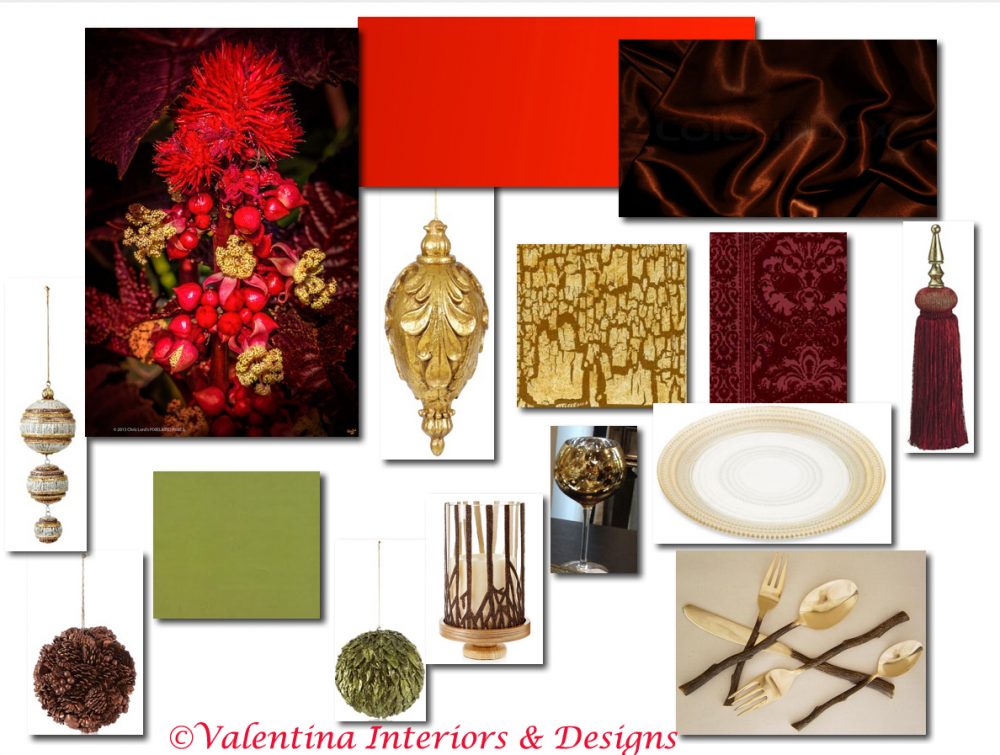
A new on-line client from France hired me to compose a warm color scheme complete with furniture suggestions that is in tune with her Autumn archetype. I went to my nearby park to get inspiration. The leaves are yellowish, brown, burgundy and if I stand in the right light I can see undertone colors like lavender, grey or chocolate. The jewel tones of the Autumn are amazing and really suit me. Fortunately, this new client likes them too.
I took many pictures of the leaves fallen on the ground and studied them in-depth. The yellow color in the  Autumn leaves, although beautiful,  indicates that the chlorophyll and oxygen are gone, therefore the leaves are lifeless and fall to the ground. The yellow has many undertones, from sandy color to golden beige and brown.  Some grayish leaves with lilac tones spotted with burgundy really intrigued me. Amazing how something lifeless as these leaves still retains an attractive beauty!

The palettes for my French client contains all the colors I saw in dead leaves transferred in the furnishing and accessories suggestion.  I gave her two solutions, one with walls in Grey and the other with walls in Chocolate Brown as shown in my video. Each background color sets a different mood.

Of course, I can go with a hotter color scheme in burgundy, light brown, beige and Sky Blue on the walls. With this third color scheme, I will substitute the silver console with a piece of furniture in brown or sand color.

While  I am waiting for the client’s response, I would like to know which of these color schemes is your preference?
Designing on-line is not any difficult than designing in loco. The challenges and the energy are the same, except that I am not physically on the project and a lot of things I do, become the client’s work, like overseeing the project development and managing contractors.

Sharing is caring. Ciao,
Valentina
http://www.valentinadesigns.com

Copyright © 2013 Valentina Cirasola, All Rights Reserved

ValentinaBlueStampIt’s my hope that through my writing I am enriching your aesthetic sensibility towards design, style and inspire you to live in beauty. I have loved my profession as an interior designer since 1990. I am here ready to offer consultations on-line if you need it. Check out my latest book on colors
©RED-A Voyage Into Colors, available on

Amazon: http://goo.gl/xUZfk0
Barnes&Nobles: http://goo.gl/q7dQ3w

Closet Doors Are Often Forgotten | Valentina Cirasola | Interior Designer

Many areas of a home are often left undecorated, as if they don’t belong to the house. Services areas for instance are treated like the “Maid Quarters” as if only second-class people live there and guests are prohibited access to.
Saving money on these areas is one reason for using low quality material and no design thoughts whatsoever. Most people settle for shelves and good appliances, the rest is non-descriptive.
Sure there is no attraction in the laundry rooms, closets, pantries, storage rooms, but what if these areas open into the beautiful parts of the home? Let’s say the laundry room’s door opens in a well-designed kitchen, wouldn’t it look better if the façade of that door was designed to disguise the laundry room entry?

I take any opportunity to change even a simple door into a painting canvas, like the mural I painted on a linen closet made of two doors and six drawers. This mural breaks the monotony of a long corridor and adds the element of surprise. If guests go to the bathroom near by, I hear a big “WOW, what is it?” all the time. The façade of this closet represents an Italianate style building.
Here I’ve put together a roundup of examples to help creativity flow and personalize your home.

Ciao,
Valentina
http://www.valentinadesigns.com

Copyright © 2013 Valentina Cirasola, All Rights Reserved

Val:FarfalleStampValentina Cirasola transforms and creates spaces realizing people’s dreams in homes, offices, interiors and exteriors. She infuses your everyday living with a certain luxury without taking away a comfortable living. 
She offers design consultations on-line through Skype and the traditional in-house consultations, helping people with their design challenge any where in the world. She is the author of three books. ©RED-A Voyage Into Colors is on the subject of colors. All Valentina’s books are available on
Amazon: http://goo.gl/xUZfk0
Barnes&Nobles: http://goo.gl/q7dQ3w

Sitting On Pediments For Centuries | Valentina Cirasola | Interior Designer

http://myatozchallenge.com/2012/02/20/welcome-to-my-a-to-z-challenge-2/

Welcome to my personal A to Z Challenge on the subject of Home.
The goal, in a year time, is to elaborate and dissect topics regarding the Home not as containers of stuff, but as a cocoon for the soul, mind and heart. I will touch on decorations, style, trends, history of home and sometimes technical information.

*****

Oh, come to mama! I opened the window of my hotel in Venice and saw the naked statues of the building right across the street. Every morning the scene of naked statues sitting on top of pediments was more interesting than the action in the street down below. The male statues carved in marble stood on the pediment in all their male beauty oblivious to the passage of time.

If we look at any Greek temples, a Pediment is the triangle gable built above a colonnade filled with sculptures representing humans and sometimes animals in some type of action. Pediment decorated each entrance, front or back, of any temple  and each pediment told a different story. Sculptures were not made all together, marble is a hard material and much time passed between one chisel and the other. Due to different time of fabrication, we can see now the evolution of the species through the art of sculptures. The gable being a triangle with two slender corners, limited the placement of standing statues in all their height, thus reclining figures, kneeling figures and figures with bent knees were the only positions for depicting statues.

We are accustomed to see statues in the pristine white of the marble and never gave a second thought that Greeks took inspiration from the Egyptians and used very bright, contrasting colors, at times even garish for the background of pediments and for the statues. Temples were the houses of Gods and places of worship, thus always built high up on hills, perhaps the reason for coloring sculptures and the background of pediments was to be seen from afar when ships approached the islands.

Romans copied the pediment idea from the Greeks and placed it on top of their temples built all over the Empire. Since then, the shape of a pediment continued through various periods and various architectural styles evolving in pointed, curved and broken pediment, the latter became the most used pediment in the very ornate Baroque period. Today we still build homes with pediments and we have extended its application to furniture, mirrors, fireplaces, entry doors and interior doors, windows and roofs. We still call it the “classical” style as the Roman did when referring to Greek architecture.  Certain details never go out of vogue!

If you like the classical style, ask me how to add value to your home with timeless features. Ciao,
Valentina
http://www.valentinadesigns.com

Copyright © 2013 Valentina Cirasola, All Rights Reserved

ValentinaBlueStampIt’s my hope through my writing to enrich your aesthetic sensibility towards design, style and inspire you to live in beauty. I have loved my profession as an interior designer since 1990 and seen many happy people after I leave a project. I am here ready to offer consultations on-line via Skype if you need.
Check out my latest book on colors ©RED-A Voyage Into Colors, available on
Amazon: http://goo.gl/xUZfk0
Barnes&Nobles: http://goo.gl/q7dQ3w

Previous Older Entries Next Newer Entries

No Facilities

Random thoughts, life lessons, hopes and dreams

Graffiti Lux Art & More

Luxuriating in the Arts - Art Remembers Us

AI Automation & Business Solutions - AI Trends | AI Insights

AI News & Insights - Artificial Intelligence Trends | Technology

Before Sundown

remember what made you smile

James J. Cudney

Best Selling Author of Family Drama & Mystery Fiction

Robbie's inspiration

Ideas on writing and baking

The Write Stuff

"Writers Helping Writers" with Marcia Meara & Friends

Jacquie Biggar-USA Today Best-selling author

Read. Write. Love. 💕💕💕

Banter Republic

It's just banter

Stevie Turner

Author of Realistic Fiction

Warning:Curves Ahead

reasonably photogenic and relatively stylish

Sue Vincent's Daily Echo

Echoes of Life, Love and Laughter

London Life With Liz

A lifestyle blog with a little bit of everything.

Janaline's world journey

My sometimes Strange, but usually Wonderful Experiences and Adventures as I Travel through this amazing World we live in.

Dancer Attitude

"Shoot for the top"

Modern Tropical

Welcome! Immerse yourself in the colorful world of Modern Tropical, an eclectic lifestyle brand for people who love the retro-modern beach aesthetic. It is produced by independent award-winning artist Kristian Gallagher.

Smorgasbord Blog Magazine

Blog magazine for lovers of health, food, books, music, humour and life in general

Jean's Writing

Jean M. Cogdell, Author-Writing something worth reading, one word at a time in easy to swallow bite size portions.

Sisi Hidupku

My Mobile Diary

Valentina Expressions

Luxury for Comfortable Living and Good Life Through Designs, Style, Travel, Food

Cindy Knoke

Photography, Birds and Travel