Caressing The Past | Valentina Cirasola | Interior Designer

Share

This year I feel very honored to have been one of the designers selected to decorate Christmas at the Historic Ainsley House in Campbell, CA.

The owner, John Colpitts, a British native, built the House in the 1920s as a retirement home. John came to California in the late 1800s and made his fortune canning food, which he exported to England to his brother.

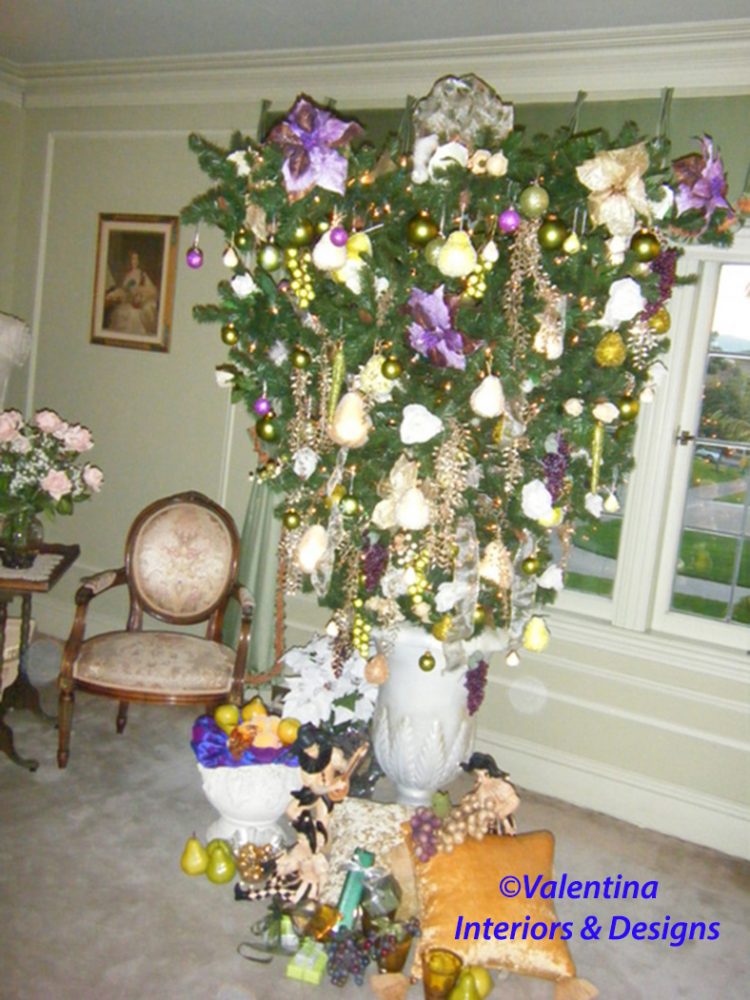


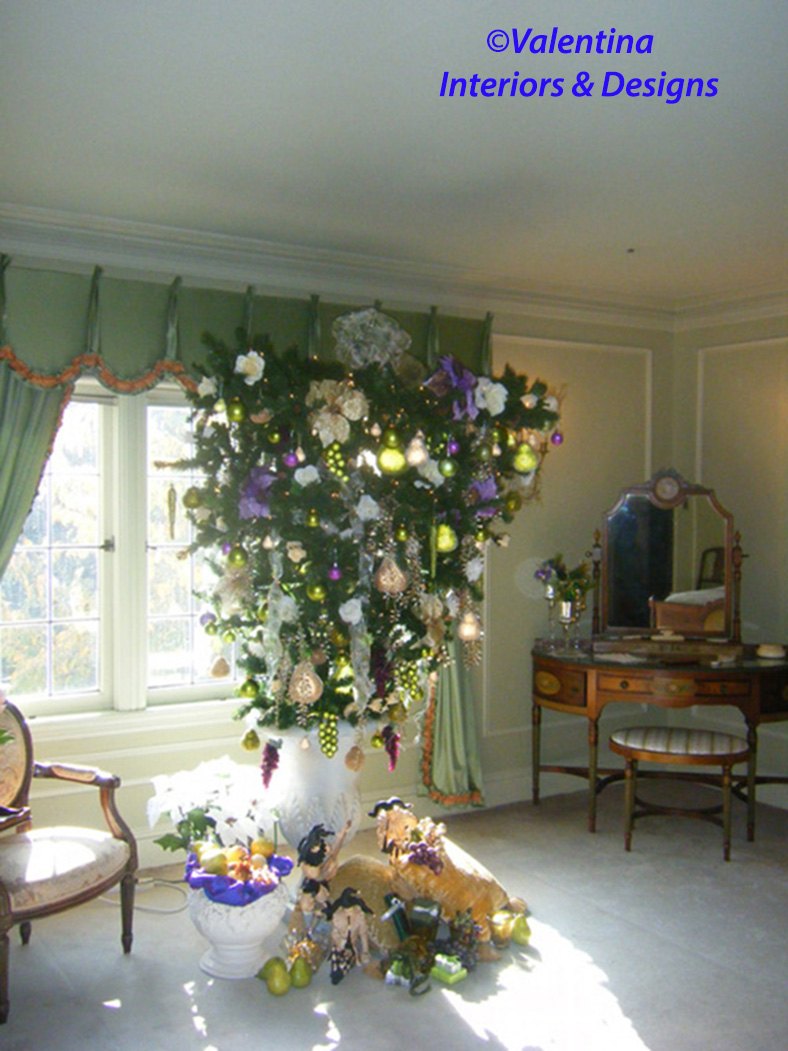
This year Christmas theme was “Christmas Around The World”. Being Italian born I thought of bringing a bit of the Amalfi’s flavors into my decorations, with citrus fruit, grapes, roses, camellias, and the typical poinsettia. My color scheme has been platinum, green, white, with a touch of purple and gold as accents throughout the guest bedroom, boudoir, closet, and cosmetic parlor.

Cosmetic Parlor

Cosmetic Parlor

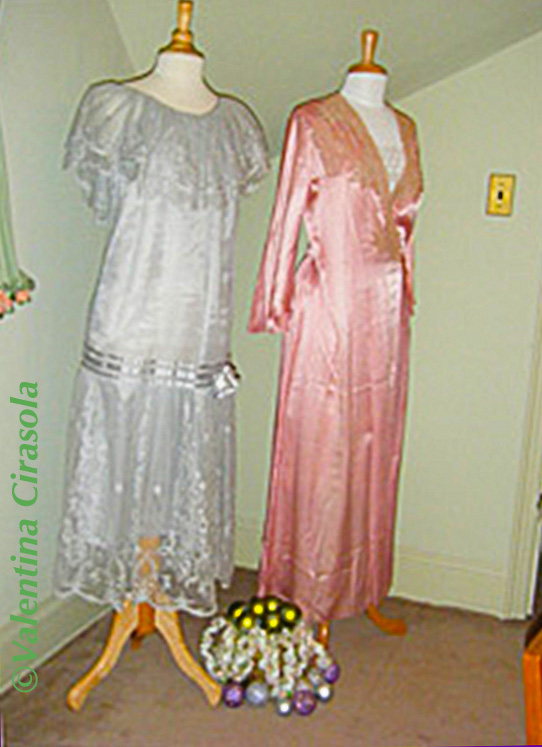
The guest quarter is a very delicate room, with powdery pastel colors fit for an elegant woman. Original 1920’s dresses are kept beautifully on mannequins and inside of the closet, while originals accessories peek through an original traveling trunk resting in the boudoir. I was so surprised to see a cosmetic parlor in the boudoir. It is a simple pedestal sink with a lighted mirror above and monogrammed face towels hanging on the bar, all concealed beyond a door when not in use. What a nice feature! Small features and details such a cosmetic parlor have ceded the way to large bath spaces, which, at times, I feel they are totally sterile and without a soul.

While I was in the attic of the House selecting the items for my Christmas decorations, I felt so much part of that era. The director was telling me that J.C. the owner, kept his liqueurs in the basements beyond some wood panels. The Prohibition Law marked the era, but we all know that when something is forbidden, we want exactly the object of sins. The story goes that the highlight of the Ainsleys’ parties was to turn all the lights off and make the guests find the door to the basement where the liqueurs were kept.

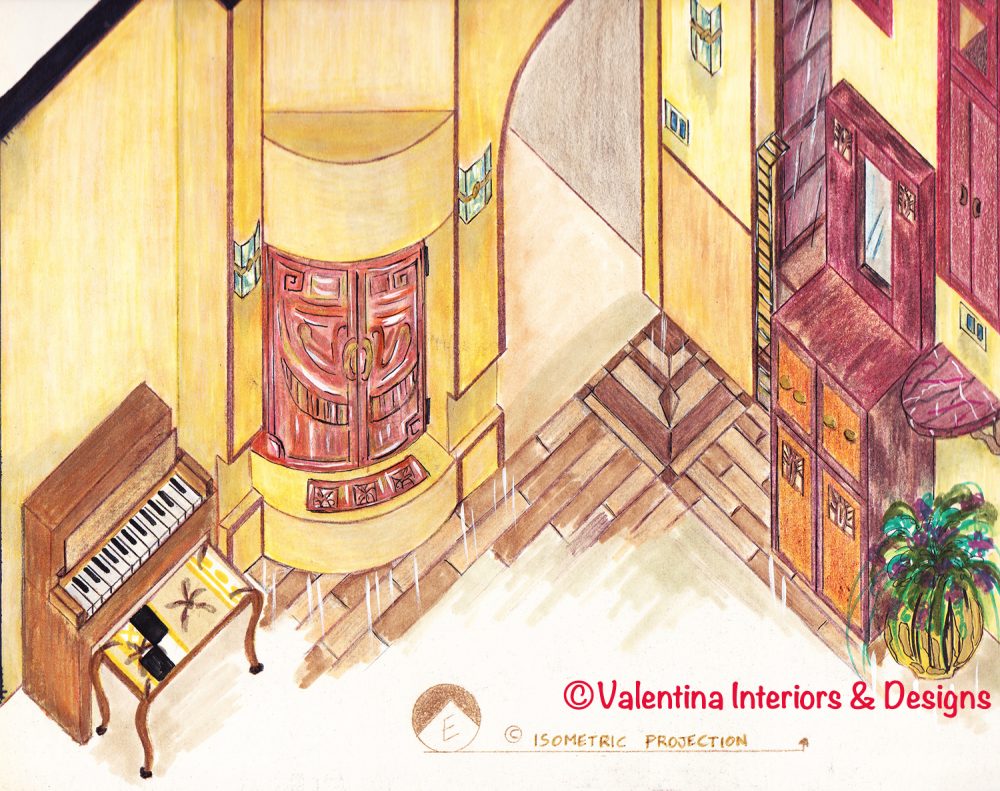
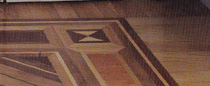
Going up and down the stairs from the attic, I could not help admiring the hardwood floor beautifully concerted almost as inlay work, the type of setting that would require the artistry and clinical eye of an ebonist. Custom flooring is another area of designing that has ceded the step to a less expensive and faster application.

The House was designed with 15 rooms in a style of Tudor Revival architecture with the influence of Arts and Crafts movement of the 1920s. The most striking feature is the English style thatched roof, remade in 2007 as a faux thatched, but one can also admire the half-timbering façade, the interior wood paneling, the multi-paneled windows and the bay windows, especially the corner one at the breakfast room.
During my conversation with the curator/director, I learned that in 1990 the House was lifted up in its entirety and moved about 1.5 miles to the present location in Campbell, CA. One would think tiles would come apart, the floor would open up and walls would create cracks during the house moving, but nothing came undone. The workmanship was really a mastery, I can adduce.
 

Boudoir

Boudoir


The modernity of the guest bathroom style really struck me, the entire bath is quite spacious. The tub is enclosed in a Tudor style alcove surrounded by Nile green tiles, the shower is separated from the tubs, enclosed with a glass door and finished with the same color tiles with three water jets, a very avant-garde detail to find in bathrooms of that era. A deep linen closet and an enclosed W.C. make this a desirable spa, just as we intend it today.


Christmas_in_Amalfi
Christmas_in_Amalfi


Alcinda was in love with John Colpitts, who was a workaholic with a strong character and played hard to get. The only way to get him to pay attention to her was to accept a job in his firm as his bookkeeper. Alcinda was 17 years younger than John, but she became his wife at last. A medium, while visiting the house a few years ago, felt a massive male energy, so I was told. I felt the same while I was decorating the upstairs guest bedroom, an enveloping warm male presence, perhaps he was a woman’s charmer. He had many visitors from Europe sojourning in his house. I can see the care that was given to the guest bedroom, made delicately elegant and comfortable for a woman. For the same reason, I wanted to give the room the same gentleness using soft Christmas colors and a certain daintiness with the flavors of romantic Amalfi.

The Ainsley House will be open every day from Nov. 20th to Dec. 19th. Calendar of events will include Holiday Teas and Tours, Holiday Boutique, Photo with Santa and Holiday Open House.
I have enjoyed the experience of caressing the past in a prestigious historic home and especially have enjoyed the comments on my upside-down tree.

Perhaps next year, I can be called to decorate your Christmas with a special theme at your home. Ciao,
Valentina

http://www.valentinadesigns.com

Copyright © 2010 Valentina Cirasola, All Rights Reserved

Share

Valentina Cirasola is a trained Italian Interior Designer in business since 1990. Being Italian born and raised, Valentina’s design work has been influenced by Classicism and stylish, timeless designs. She will create your everyday living with a certain luxury without taking away your comfort. She loves to restore old homes, historic dwellings and she focuses on remodeling. Check out her books on
Amazon: http://goo.gl/xUZfk0
Barnes&Nobles: http://goo.gl/q7dQ3w
Floors To Trample and Knocks You Out With Warmth | Valentina Cirasola | Interior Designer

Share

What do you think of the hardwood floor that looks like a chopping block? Do you like to see short wood planks in light and dark coloration laid-out in the chopping block fashion? I don’t. There is nothing elegant about it. The look of a kitchen should stay on the kitchen counter.
A few days ago, I was looking at an Italian fashion magazine, but I could not help noticing more the hardwood floor than the clothing. Yes, the clothing were attractive, but the floor they were casually thrown on was sexy, warm, inviting, onto which the fashion clothing seemed even more interesting in their casual lack of concern. The picture to me spoke about the hardwood floor, as if the wearer had trusted the beautiful hardwood floor to take a gentle care of her precious jewelry and the fancy garment.

Italian floors have been the most remarkable floors in history. Italian people like to trample on beauty because what is under their feet is as important as what they wear on their feet. Floors in Italian homes can be very decorated, or have an understated elegance, both ways will affect and determine the ambiance of a home. It is a common practice to blend and mix various wood species to create attractive pattern designs, which at times do not follow any direction and at times will take the eye in a state of ecstatic admiration.

Hardwood floor focus on the emotion it evokes and the dreams that surrounds the wood itself. Designed hardwood floors are for sitting on, for rolling while playing and to allow us to be enveloped by its natural warmth. Cushions, crackling fireplace, a glass of wine, scented candles, a good company with an elegant music and I have just created a relaxed glamour right on the hardwood floor.

Another common practice is to design a floor with marble or tiles inserted in the hardwood as accents, but the classic and long-lived solution remains the mixture of intricate designs of stones communicating beautifully with each other, both in contemporary and classic forms. Mosaics made of various stones and wood inlays are not only for churches and museums, but they are vastly appreciated in most homes in Italy.

Travertine and tumble marble cover the floor of my house in Italy. Although these are kind of warm stones, in super hot days this type of stones can provide an instant pleasurable refreshment and I love to roll on the floor. As a kid I loved to go down the stone stairs not with my feet walking down, but with my butt sitting and feeling the steps one by one until I reached the floor. I was a little rascal and…. still I am in so many ways.

The floor setters in Italy are artists of their own kind. Being exposed for centuries to beautiful floors they are a delight to work with, they are original and knowledgeable and they are the best people to ask for suggestions when clients have no idea of how to compose a floor. As a designer, I like to guide them around my design concept when I compose certain hard surfaces, but their expertise is of a superior quality that not much guidance is needed once the designs is laid out on paper.

(Floor left: Romeo Cuomo)

To create a composition of marble with various stones to me is a divertissement.
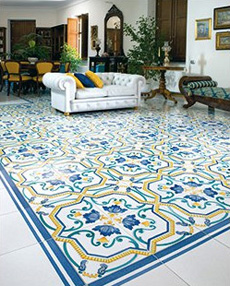
Any area of a home can do without area rugs and be defined with a stone design instead, as in photo. It will save on rug cleaning expenses and the room will be more hygienically breathable. Stones only need water and mild soap and they will be dressed again.

Find this beautiful hand painted tiles flooring shown here at Officina Ceramica in Italy: http://www.officinaceramica.com

Whether you are thinking of hardwood floor, or stone floor and whether it will be installed in a home on the Amalfi Coast, Côte d’Azur, California, or any urban flat in the world, I will suggest to employ any material intelligently, create the beauty even under your feet. Beauty and luxury have a vital role to play in the most intimate and important moment of a person’s life.
Originally designed hard surfaces will endure the test of time, will add value to your home and above all will continue your dream and legacy, as we still dream today when visiting historic homes and buildings around the world.

If you are ready to step onto dreamy flooring and if you ready to invest into long-term beauty, I am here to help you. Should anything like this strike your fancy, I would like to be the designer to provide you with these special solutions ready and available to me. Ciao,
Valentina

http://www.valentinadesigns.com

Copyright © 2010 Valentina Cirasola, All Rights Reserved

Share

Valentina Cirasola has been in business as a designer since 1990. She has helped a variegated group of fun people realizing their dreams with homes, offices, interiors and exteriors. She is a designer well-known to bring originality to people’s homes. As an Italian designer and true to her origins, she provides only the best workmanship and design solutions. Check out her books on
Amazon: http://goo.gl/xUZfk0
Barnes&Nobles: http://goo.gl/q7dQ3w

So Rich Poor Art | Valentina Cirasola | Interior Designer

Share

I like to fantasize about a period décor, the antiquity, traditions, elegant woods, beautiful but simple furniture, how about you? Perhaps you see yourself sipping a glass of aged Bordeaux wine while sitting by a carved stone fireplace, you know, that kind which has a large mouth and a very tall mantel. I remember one of those in my grandmother’s home when I used to stand in it and feel completely tall. It is a nice feeling to go back in time and sense the enveloping of classicism and the warm atmosphere of the past. Do you like to smell the wood and do you appreciate looking at the craftsmanship of artisans who worked on wood like a sweet poetry? Then you would like “Arte Povera” in your home.

Arte Povera, literally “Poor Art” is a movement which started in Italy in the decade between 1960 and 1970 by the Italian art critic and curator Germano Celant. It sprung up as a rebellion and as a rejection of the convoluted and massive Italian furniture used before World War II. Urban artists from Genova, Milano, Torino and Roma exhibited their works in various galleries showing a new concept of making art using poor and recycled materials and bringing art into a new dimension. The ‘60s in Italy were turmoil times, every level of culture was attacked by cynicism, skepticism and rejection of the past, but it was also a time which a new consumerism was embraced. Italy, as the whole Europe was enjoying a new post-war wealth, consuming every possible merchandise was a very attractive idea. I remember the first Vesta and Lambretta (mopeds) and the first, very exciting Fiat 500. What a jewels they were! Contradiction, modernity and simplicity marked the ‘60s in Italy.

Arte Povera as I said started as a rejection of the heavy and classic bourgeois art of the past. The new concept of furnishing in the ‘60s was conceived with simplicity in mind, taking inspiration from the simple woods and linear shapes of the farms and country life, but some other furnishing were made with new everyday materials, interchangeable, vibrant colors, anything and everything was used as the new material, making Arte Povera so modern and surprisingly contemporary even for this new millennium.

Last year I went on vacation and spent a few days at a B&B in the Salento area, a southern Italian region. The architecture was a typical farm-house with stone walls and vaulted ceiling also made of stones. Furnishing was made of decape’ farmer’s pieces and soothing colors. My room was beautifully elegant in its simplicity of Arte Povera, it was very homey and cozy, but the price was not at all poor. I must say that since in Italy furnishing in the Arte Povera style is in high demand, it has become very expensive.
Decape’ style, or Shabby Chic is one style comprised in the Arte Povera. This is the perfect style to renovate old furniture that has little value. With a few paint techniques, it is possible to exalt the simple beauty of an old piece and to create a romantic retro environment.

In the kitchen I have designed for one of my client (photo), the kitchen cabinets were made of oak stained in dark walnut, the client brought in an old dining table from a farmer that really added character to the kitchen room. The look we were after was that of a country Italian kitchen, but every detail was well-studied and executed with the same care and passion characteristic of the poor farmers making their own furniture by hand. (Click on each photo to view it larger).


My experience of decades in interior designing allows me to rebuild or restore any décor by taking care of the small details that will change your home into a master piece, even if it is decorated as a “Poor Art”. If you have a creative vein, you can tackle a project of refinishing a piece of furniture in the decape’ or poor art style, but if you want a well-researched and sophisticated look in the Arte Povera you should consider working with a professional. This is why many people are discovering the benefits of working with me as their trusted interior designer and consultant, someone who can make you feel at home in all of your dreams and decisions. Ciao,

Valentina

http://www.valentinadesigns.com

Copyright © 2010 Valentina Cirasola, All Rights Reserved

Share

Valentina Cirasola is an Italian Interior Designer in business since 1990. She loves to remodel homes and loves to turn unattractive spaces into castles. Being Italian born and raised, Valentina’s design work has been influenced by Classicism and stylish, timeless designs. She will create your everyday living with a certain luxury without taking away your comfort. Check out her books on
Amazon: http://goo.gl/xUZfk0
Barnes&Nobles: http://goo.gl/q7dQ3w

Ritzy and Spiffy | Valentina Cirasola | Interior Designer

Share

Vintage, what a passion! The flapper girl loved all that allowed her to be and feel free in her behavior.
Louise Brook, the diva of silent movies adopted the short hair cut à la garçon that every woman copied. The short bob emphasized the sensual curve of the neck, while the facial features under a cloche hat were enhanced with a well-studied maquillage. The flappers girl loved very red lips and nails, lunar skin, very long eyelashes, marked the eyes with a smoky black eye liner and completed the look with long pearls necklaces. She loved to wear short dresses above the knee, showing them off for the first time in the history of fashion. Designers Coco Chanel and Paul Poiret, in Paris called “Le Magnifique” liberated women from corsets or other body traps and put them in chic sexy gowns.

This past Halloween I was invited to a 1920’s party. The house was so beautifully staged in that period style that I felt prompted to write about how to reproduce the same style in today’s home.

In Europe, the 1920s’ style had a different name in each country. It was Liberty Style in Italy, Art Nouveau in England, Style Guimard in France named after designer Guimard, Modernism in Spain, Secession Style in Austria and Youth Style in Germany. Regardless of how it was named, Art Nouveau flourished between two World Wars and it was a celebration of youth style and liberation from fussiness and constrictions. Key words to describe 1920s’style were simplicity, functionality, efficiency and cleanliness of lines and forms. Colors choices of that time are so modern even for today’s living:
Black, White, Ivory and Gray for the neutral palette, Nile Green and Navy Blue for the cold palette, Canary Yellow and Mandarin Red for the warm palette.

There was a certain flavor of world style design, traveling was popular, discovering treasures of different countries was exciting and decorating with traveling memories was fashionable.

Steamer trunks with travel labels in lieu of coffee tables, Oriental rugs for the living room and scenic prints on the walls, legendary beasts as accessories and floral art glass were all the rage, along with subjects of lavish birds, flowers, insects and femme fatale details. Abstract lines and shapes were used widely as a filling and mixed in with all subjects.

The new concept of open spaces was born with the Bungalow Style architecture, which essentially was the new style home for the middle class, small but functional and comfortable. To create a visual effect of larger spaces, rooms opened up into each other, kitchen into family room and into dining and to avoid a cluttered look most of the furniture was built-in, such as bookcases, breakfast nooks, sideboards, china cases and window seats. Furniture was made to last and with sturdy luxurious woods such as mahogany and cedar and was designed in simple lines and simple carved details.
(Photo Bungalow right found on: http://www.angelfire.com/retro2/lisa3/20shome.html)

As you see, the 1920 ‘s style fits so perfectly in today’s living. Keep it simple and clean. Built-ins will substitute many furniture pieces that generally stand on the floor, allowing you to free floor space. Keep all the shapes linear, but splurge on accessories and sexy lamps to create several light points to suit every mood. Emphasize colors. Combine rich hardwood floor with retro chic’s bold wall colors and contemporary forms to achieve a fresh cheerfulness and whimsy. Reproducing with paint a typical 1920’s wallpaper motif is an easier alternative to wallpaper that might not exist anymore. Complete the décor with ornamental glass work on doors and divider panels; some metal/chrome features like sinks on chrome legs, or fireplaces brass façades; mirrors, Murano glass chandeliers and graphic art.

The 1920’s style is very current and conducive with my living. I like stylish décor nobody has, I like to set moods with attractive period pieces and I like to surprise people visiting my home. How about you? Tell me what is your style, I can reproduce it ritzy and spiffy without taking away your comfortable life and any of your habits. Ciao,
Valentina

http://www.valentinadesigns.com

Copyright © 2010 Valentina Cirasola, All Rights Reserved

Share

Valentina Cirasola is an interior designer well-known to bring originality to people’s homes. As an Italian born and true to her origins, her design work has been influenced by Classicism and stylish, timeless designs. She provides only the best workmanship and design solutions.
Check out her books on
Amazon: http://goo.gl/xUZfk0
Barnes&Nobles: http://goo.gl/q7dQ3w

No Facilities

Random thoughts, life lessons, hopes and dreams

Graffiti Lux Art & More

Luxuriating in the Arts - Art Remembers Us

AI Automation & Business Solutions - AI Trends | AI Insights

AI News & Insights - Artificial Intelligence Trends | Technology

Before Sundown

remember what made you smile

James J. Cudney

Best Selling Author of Family Drama & Mystery Fiction

Robbie's inspiration

Ideas on writing and baking

The Write Stuff

"Writers Helping Writers" with Marcia Meara & Friends

Jacquie Biggar-USA Today Best-selling author

Read. Write. Love. 💕💕💕

Banter Republic

It's just banter

Stevie Turner

Author of Realistic Fiction

Warning:Curves Ahead

reasonably photogenic and relatively stylish

Sue Vincent's Daily Echo

Echoes of Life, Love and Laughter

London Life With Liz

A lifestyle blog with a little bit of everything.

Janaline's world journey

My sometimes Strange, but usually Wonderful Experiences and Adventures as I Travel through this amazing World we live in.

Dancer Attitude

"Shoot for the top"

Modern Tropical

Welcome! Immerse yourself in the colorful world of Modern Tropical, an eclectic lifestyle brand for people who love the retro-modern beach aesthetic. It is produced by independent award-winning artist Kristian Gallagher.

Smorgasbord Blog Magazine

Blog magazine for lovers of health, food, books, music, humour and life in general

Jean's Writing

Jean M. Cogdell, Author-Writing something worth reading, one word at a time in easy to swallow bite size portions.

Sisi Hidupku

My Mobile Diary

Valentina Expressions

Luxury for Comfortable Living and Good Life Through Designs, Style, Travel, Food

Cindy Knoke

Photography, Birds and Travel